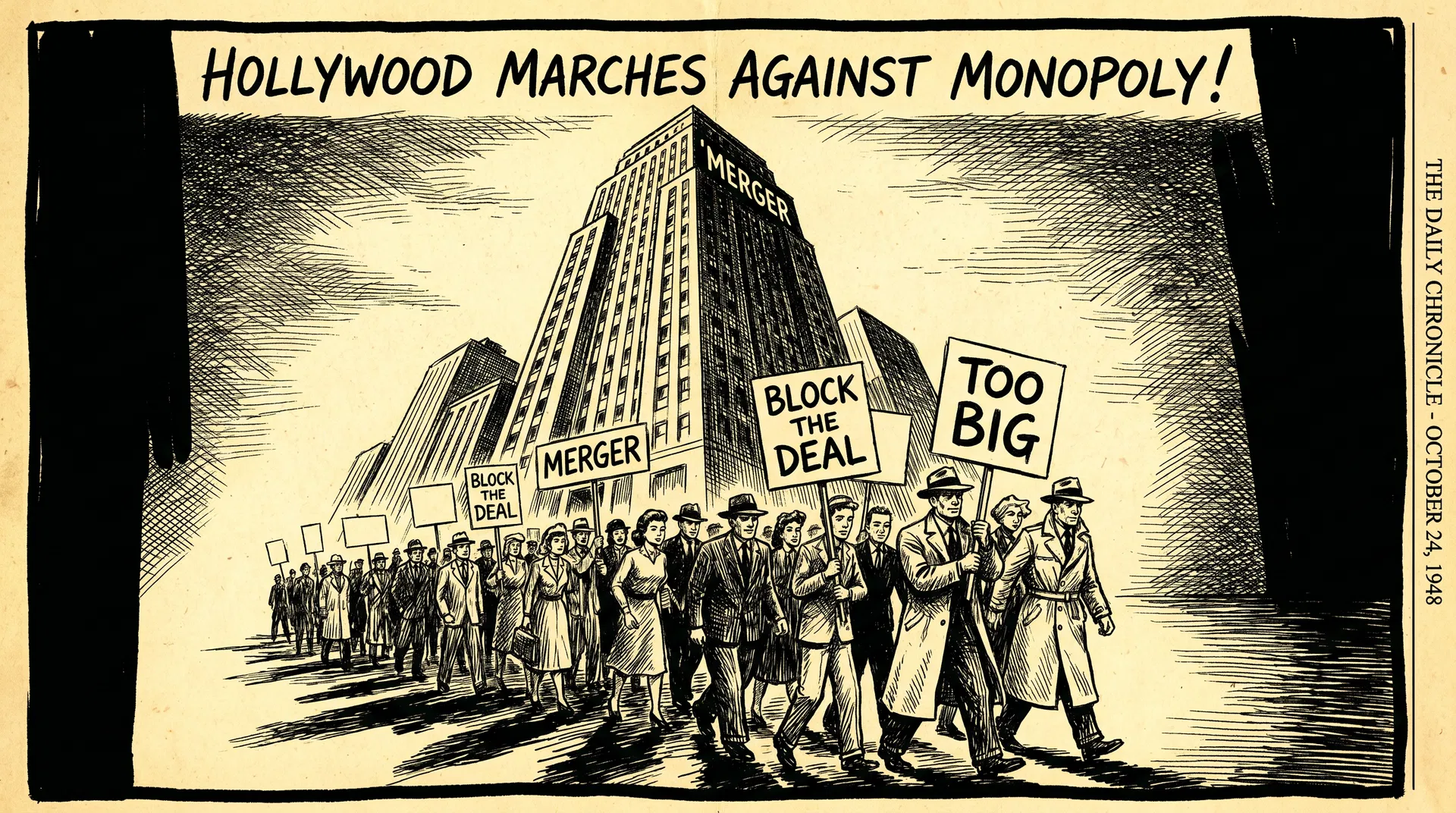
Over 1,000 Hollywood Names Just Told Washington: Block This Deal
On Monday morning, a letter landed in Washington that Hollywood hasn't seen in a generation. Over 1,000 actors, directors, writers, and producers — Bryan Cranston, Glenn Close, Ben Stiller, J.J. Abrams, Lin-Manuel Miranda, Joaquin Phoenix, Jane Fonda, Denis Villeneuve — signed their names to a single document expressing "unequivocal opposition" to the proposed $110 billion merger of Paramount Skydance and Warner Bros. Discovery.
The letter, organized through Jane Fonda's Committee for the First Amendment and Norm Eisen's Democracy Defenders Fund, calls on California Attorney General Rob Bonta and federal regulators to block the deal outright. The argument is direct: this merger would reduce the number of major U.S. film studios to just four, cutting jobs, raising costs for audiences, and concentrating creative power in the hands of a smaller group of executives than at any point in Hollywood history.
What makes this letter remarkable isn't just the names on it — it's who signed despite having active deals with the studios involved. J.J. Abrams has a current production deal with Warner Bros. through Bad Robot. Denis Villeneuve is releasing Dune 3 through Warners later this year. David Chase has a new project at HBO. These aren't outsiders lobbing criticism from a distance. These are people who work there, who know what a merger of this scale does to creative culture, and who signed anyway.
Damon Lindelof, the creator of Lost and Watchmen, posted a candid note on Instagram explaining why he almost didn't sign. "I felt two things," he wrote. "The first was that yes, absolutely, of course I opposed it. The second was oh shit, I'm afraid to say so publicly." He signed anyway. That kind of honesty — naming the fear and doing it anyway — is what gives this letter its weight.
Paramount pushed back the same day, calling the merger a response to disruption from big tech and promising to keep releasing at least 30 films per year theatrically. Theater owners, meanwhile, are fighting the deal from a different angle — Cinema United, the top theater trade group, pledged this week to continue opposing the merger even after Paramount CEO David Ellison flew to CinemaCon in Las Vegas to personally reassure exhibitors. The Senate Judiciary Committee held a public forum Wednesday. This thing is going to a fight.
Netflix Just Made $5 Billion in One Quarter — and Its Founder Is Walking Out the Door
Netflix reported Q1 2026 earnings Thursday, and the numbers are staggering. Revenue hit $12.25 billion, up 16% from a year ago. Net income surged 83% to $5.28 billion — more than $5 billion in profit in a single quarter. That's not a streaming company anymore. That's a media empire.
A significant chunk of that profit — $2.8 billion — came from the breakup fee Netflix collected when the Warner Bros. Discovery acquisition collapsed earlier this year. Netflix had bid to acquire Warner Bros., the deal fell apart, and Warners owed Netflix a $2.8 billion termination fee. So Netflix got paid $2.8 billion for a deal that never happened. That's the kind of leverage that only exists when you're the most powerful company in the room.
The same day earnings dropped, Netflix announced that co-founder and executive chairman Reed Hastings will not seek re-election to the board when his term expires in June. Hastings, who built Netflix from a DVD-by-mail company into a $400 billion streaming giant over 29 years, is leaving to focus on philanthropy. He's not being pushed out. He's choosing to go. But the timing — the day Netflix posts its biggest quarterly profit ever — is the kind of exit that only the most confident founders can pull off.
The stock dipped slightly after earnings because Netflix declined to give 2026 subscriber guidance, which Wall Street hates. But the underlying business has never been stronger. Netflix is no longer chasing subscribers — it's monetizing the ones it has, through advertising, live events, and price increases. The era of growth-at-all-costs is over. The era of profit is here.
Euphoria Is Back — 8.5 Million People Showed Up in Three Days
Euphoria Season 3 premiered April 12 on HBO and HBO Max after a four-year hiatus — and 8.5 million U.S. viewers showed up in the first three days. That's a 44% increase over the Season 2 premiere in 2022. For context: that's better than most theatrical blockbusters open domestically in their first weekend.
The show came back with controversy already baked in. Early reviews landed at 62% on Rotten Tomatoes — mixed, by Euphoria standards — and some critics took issue with specific creative choices in the premiere. None of it mattered. The audience showed up anyway, because Euphoria isn't a show people watch because critics tell them to. It's a show people watch because it's an event, because the cast is magnetic, and because four years is a long time to wait.
The bigger story here is what this means for HBO. Euphoria is the network's clearest proof that prestige drama still drives mass audiences when the show is genuinely great. The Pitt is doing it in a different register. The White Lotus did it earlier this year. HBO's strategy — fewer shows, bigger bets, higher quality — is working. And that strategy is going to look very different if the Paramount-Warner merger goes through and Warner Bros. Discovery gets absorbed into a larger corporate structure.
Brian Williams Is Coming Back — On Netflix
Netflix announced Thursday that Brian Williams — the former NBC Nightly News anchor who left the network in 2015 after fabricating a story about being under fire in Iraq — is launching a weekly video podcast for the platform called "We're Back! With Brian Williams." The show will feature interviews with newsmakers, actors, athletes, and prominent figures, debuting later in 2026.
Williams, who later anchored MSNBC's 11th Hour before leaving in 2021, has been largely out of the public eye for several years. His return on Netflix is a statement about where media is going: the biggest names in broadcast journalism are no longer going to cable networks or legacy outlets. They're going to streaming platforms that can give them a global audience, creative control, and a deal structure that doesn't require them to show up five nights a week.
Williams himself leaned into the absurdity of the moment in his announcement. "With scientists predicting that every American will have a podcast by 2030, I thought it was time to get in the game," he said. That's the kind of self-aware line that only works if you've been through enough to earn it. Whether the show is any good is a separate question. But the fact that Netflix is the platform willing to bet on him — not CNN, not ABC, not Peacock — tells you everything about where the media power has shifted.
This week was a lot. A thousand Hollywood names declaring war on a $110 billion merger. Netflix posting $5 billion in profit while its founder exits. Euphoria pulling 8.5 million viewers back from a four-year absence. And Brian Williams showing up on Netflix with a podcast. The entertainment industry is not in a slow transition. It is in a full restructuring, playing out in real time, and every week the stakes get higher.